

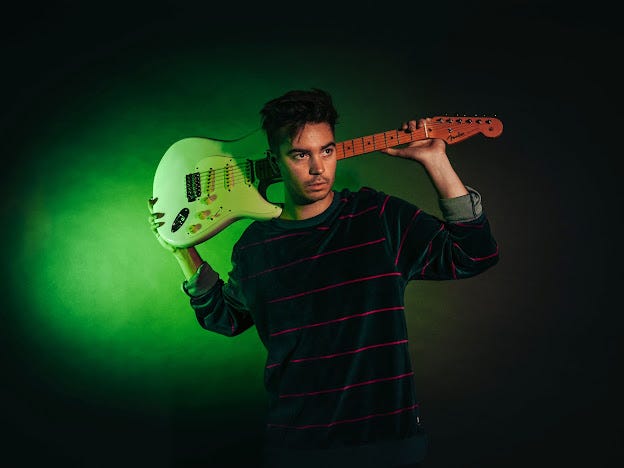
RFB.FM connected with Darksoft ahead of his eighth studio album, Everydayness, due Friday, March 6, 2026. Ahead of the digital release, Everydayness is currently available for order on vinyl and CD, on-demand via Elastic Stage, and tape cassette coming soon, self-released under Darksoft’s own imprint Look Up Records. If you’re on Spotify, you can pre-save the album here. Visit darksoft.band for more information, merch, shows, and other updates. Or follow Darksoft on social media at @darks0ft.
RFB.FM: We love the concept of Everydayness, an exploration of themes that can be simultaneously eternally true and yet entirely mundane (e.g., Too Little Too Late, Spend Your Days, etc.). How did this concept evolve for you? Tell us about the common threads between Everydayness and your previous albums.
Thanks! I’m glad the idea is getting across. Everydayness is built from the everyday. It’s more of the same, rooted in physical reality, repetitive, and super day-to-day. I literally got the name from a shampoo bottle.
The album artwork features an analemma — an infinity symbol created by photographing the sun from the same spot over the course of a year. Like the artwork, the album ponders the cyclical nature of life and day-to-day routines. Overall, its goal is to find beauty in the mundane.
While many songs speak to the gears churning of the daily grind, others reflect on a higher state of living day-to-day with more purpose and intention. That’s more in line with a meta theme I want to impart, which is having more agency and taking a “seize the day” approach to everyday life, even if it’s about the simple things.
You asked about how this album fits into my overall discography. Well, I really like songwriting with an overarching theme or concept for each album. And, I’ve been exploring universal truths in my lyrics for a while now.
In the shoegaze style, the idea is often that the vocals are more used as background instrumentation. So some years ago, I thought, what if the lyrics themselves were similarly nonexistent and textural?
For my album Beigeification (2023), I started experimenting with worn-out phrases and colloquialisms like “It Is What It Is” or “Only Time Will Tell.” But the more I did that, I sort of realized that even though they were cliché, they hold a lot of universal truth. These sayings say nothing at all but say everything at the same time. It’s all about context.
So, I leaned into that quite a bit with my writing since then, and it’s been interesting progressing that style into new themes in my last few records.
RFB.FM: Who were/are your biggest musical influences? Beyond music (e.g., art, literature, film, philosophy, etc.), what has inspired or shaped your creative journey the most? Anything that was particularly impactful?
Ah, the dreaded musical influence question! Always tough to pin this down. As far as the stuff I take direct inspiration from for Darksoft, it’s a blend of 80s post-punk, jangle pop and twee, shoegaze revival, and 90s alternative, with a modern dream pop or bedroom pop bent.
As for the classics, in alphabetical order so as to not play favorites: David Byrne, Depeche Mode, Echo and the Bunnymen, Edwyn Collins, Elliott Smith, Felt, Gary Numan, Joy Division, My Bloody Valentine, Nirvana, Orange Juice, Orchestral Maneuvers in the Dark, Primal Scream, Slowdive, Tears for Fears, the C86 album, The Cure, The Dandy Warhols, The Field Mice, The Jesus and Mary Chain, The Ocean Blue, The Ramones, The Smashing Pumpkins, The Strokes, Wire Train.
As far as literature goes, I have a habit of making literary allusions in my songs. My song “So It Goes” from Grayscale (2023) is an intentional nod to Kurt Vonnegut. He used that fatalistic phrase obsessively (106 times — I looked it up) in one of his novels, Slaughterhouse-Five. I think his writing and his dry-yet-leaning-positive nihilistic sort of take on life affected how I see the world.
My song “Spend Your Days,” the opening track of Everydayness, opens with the lyric, “how you spend your days is how you spend your life,” which is a slight rephrase of an Annie Dillard quote. I’ve always been attracted to being intentional with my time and the idea of stoicism. Some of Walt Whitman’s Song of Myself, and the idea that you can contradict yourself and you contain multitudes, is ingrained and has influenced my core beliefs and lyrics.
When preparing Everydayness, I picked up Henri Lefebvre’s Critique of Everyday Life and skimmed it a bit. I also picked up The Everyday and Everydayness, which is a more accessible small journal of short ideas from Lefebvre with really nice textural paintings by Julie Mehretu. That was a nice tone-setter.
Martin Heidegger explored a concept of everydayness he calls “Dasein” in his Being and Time, so I picked that up too. Unfortunately, it was far too dense for me. The guy seems to say absolutely nothing in the most eloquent, roundabout way while constantly name-dropping other ivory tower peers. I don’t get it. Or maybe I don’t have the patience to understand it. Regardless, Heidegger’s back on the shelf.
RFB.FM: We’re always fascinated by how the built or physical environment can help shape a record. You’ve mentioned that you recorded and produced Everydayness in your home studio in Maine. How did Maine and or the home studio environment influence the album? How does this translate into live performances?
Yup! I record all Darksoft parts (guitars, vocals, drums, percussion, synth, sound effects, bass) using real instruments (without MIDI) in my basement home studio. I typically do a lot of direct-in (DI) recording. I first start with demos and progressively add to a playlist over the course of about a year.
Then, once I have ten or so songs I’m happy with, I work with an engineer to help apply effects, re-amp some parts, and mix and master the songs to take it to the final result. Brian Fisher, a talented engineer I’ve worked with on Darksoft a bunch recently, mixed and mastered Everydayness.
The home studio is critical to my process. I’ve built a mostly plug-and-play setup so I can make some coffee, head downstairs, and chip away at ideas whenever I find time outside of work and family life. Music making is literally part of my everydayness. (See what I did there?)
Maine is beautiful and relaxing for me, and I think it’s had a positive effect overall. I love the epic turning of the seasons here. Summer, fall, and winter are much more accentuated and visceral. I live close to a river that I try to visit often to hike, swim, or trudge through the snow.
You also asked about live performances. While recording, I’m always thinking about how the songs might translate on stage, balancing layered studio ideas with what’s realistically playable live without relying on backing tracks. I see the recording as the finished artifact, but I try to walk that line so the music still works in a live setting.
Recently, the live Darksoft lineup has expanded into a five-piece with a synthesizer, which is much closer to how I’ve always envisioned the project sounding on stage. I’ve been lucky to have a core group of friends support Darksoft live through shows in Maine and even on the West Coast, where I’m originally from, throughout a handful of regional tours over the past few years.
RFB.FM: What’s one thing you would want listeners to take away from this record?
I hope Everydayness leaves listeners with more validation that their existence matters, even when they’re in autopilot mode at work or doing mundane household tasks. I hope it can provide more agency for the things you can control in your life, and inspire others to actively shape your day-to-day into whatever you desire it to become over time.
At the same time, I don’t want my music to carry that much weight or be too heady or viewed as self-help. I hope people just like how it sounds.
Also, I’m still a big believer in the album. We’re in this streaming world of single this single that. I say give a record a full spin now and then — you might like the progression and where it takes you.
RFB.FM: What are some of your favorite bands right now? Who should we be checking out?
First, go listen to “Doot Doot” by Freur. Such a unique 1983 gem I just discovered recently. And the outro really hits home. Doot, doot.
Then, go check out, again in alphabetical order: Babe Rainbow, Black Marble, Castlebeat, Cool Heat, Day Wave, Drab Majesty, EVENTYD, Found Space, Ghost Days, Glom, Heels, Hibou, JW Francis, Launder, Lost Film, Lurve, Phantom Youth, Skymender, Swiss Portrait, and Yndling. These are all contemporaries I listen to and respect. Most anything on Spirit Goth is pretty swell, too.
There’s also a dungeon synth label out of Maine called Out of Season that a friend turned me on to. Instrumental, medieval-sounding ambient music inspired by Dungeons & Dragons is basically all I listen to now. Beyond the classics like Fief or Quest Master, I’ve been digging deeper cuts like Deep Gnome and Fogweaver.